Combatting Panic with Digital and Media Literacy
How can digital and media literacy help combat the rise of panic in the wake of the ongoing Coronavirus pandemic? (Photo source)
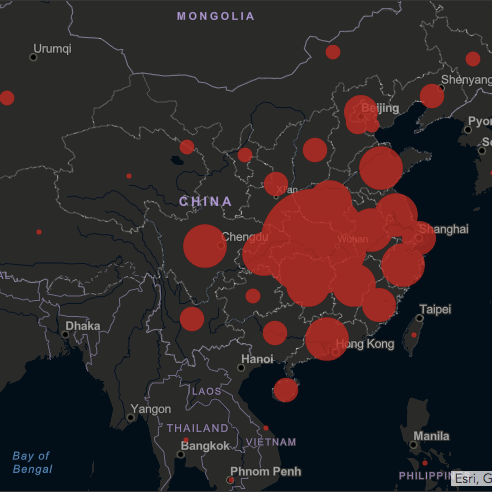
Coronavirus Spread
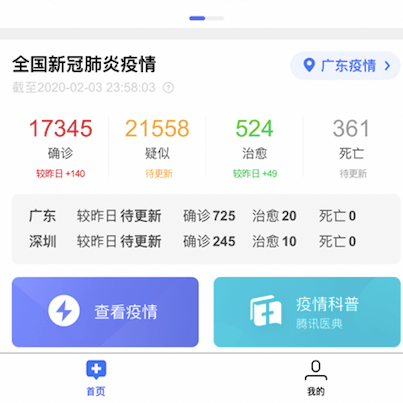
Chinese social media giant WeChat updates the 2019-nCoV spread. (red: infected; orange: suspected; green: recovered; gray: dead)
Misinformation Spread

Factcheck.org debunks 2019-nCoV misinformation in their article “Coronavirus Misinformation Spreads Like a Virus“
I am writing this post as I sit on the couch of a friend in New York City, thousands of miles away from my home in Nanjing, China. I came to the States for what was supposed to be a short visit for the Chinese New Year and have ended up stuck because of the novel Coronavirus, 2019-nCoV.
For the past two weeks, my husband and I check the news throughout the day. I check the English sites and he, a Chinese national, checks the Chinese sites. Our lives, and potentially the lives of every single person we have come across in the past few weeks, could depend upon what new information is reported.
Setting aside the difficulty of figuring out the logistics of our lives that were complicated by this contagious and deadly virus (how long will we be here, do I still have my job, how do we get money out of China, do we expedite our personal timeline and just go ahead and buy a house and car in the U.S., etc. times affinity) and our erratic and devastating emotions as we think about our loved ones unable or unwilling to leave China, we have the added task of navigating what’s real and what’s not.
Despite the feeling of isolation in this vast city, we are not alone. Countless others flip through the news or scroll through social media in search of information. People are scared so cling to what information is available without doing their due diligence, often spreading misinformation, furthering the feeling of fear and panic. This fear is leading to increased xenophobia in our country as my colleagues teaching in higher education institutions in the U.S. tell me about petitions circulating on their campuses aimed at removing all Chinese students and teachers. If fear increases, will this lead to a situation like the WWII internment camps for Japanese and Japanese-Americans? Will we round up the Chinese, too? Completely close our borders to Chinese?
In the face of this crisis, not only must we turn to our compassion and understanding, we must turn to our digital media literacy skills so that we can control the spread of misinformation and control our fears and panic.
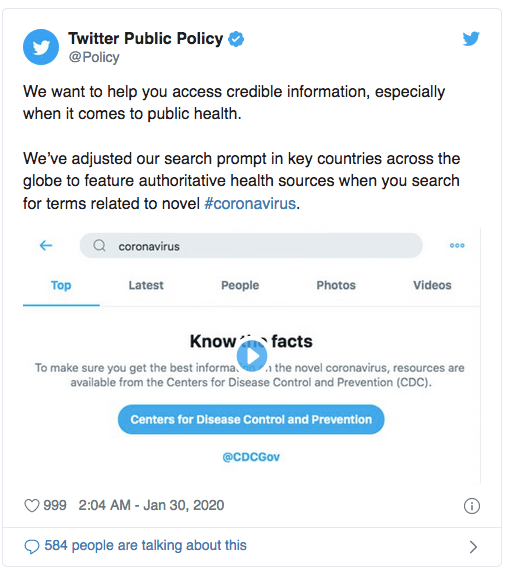
Some Big Tech companies are already fighting the misinformation surrounding the Coronavirus. Facebook will remove misinformation about the Coronavirus from its platform, Google is displaying information from the WHO in search results, and Twitter has changed its search prompt to grab information from “authoritative health sources” to the top of the page. While this is a promising start, individuals must take action as well to reduce the spread of misinformation.
Below are tips to increase your digital media literacy so that the spread of misinformation, fear, and panic can be eliminated in this time of crisis.
- Recognize there are credibility issues with many online sources. Yes, there are credibility issues with print sources as well, but the “difference is that much of the information on the Internet is not the work of professional authors, but of amateurs who have questionable expertise. On the Internet, anyone can self-publish, so the vetting that usually occurs in a traditional medium—for example, by a magazine’s editorial department—rarely happens online” (“Issues and trends,” 2017).
- Use fact checking websites to find unbiased truth. As mentioned above, anyone can post information easily on to the internet. Before sharing an article or infographic you saw on your social media, verify its information using one of a number of fact checking websites.
- Accept that news outlets don’t always have all the information, meaning you should compare multiple sources. Author Ben Stegner (2016) reminds readers to be aware of the language news posts use, paying particular attention to the nuances in the phrases like “We are getting reports,” “We are seeking confirmation,” “We have learned,” and “We have heard.”
- Distinguish fact from opinion. Reject sharing opinions unsubstantiated by evidence. Just like traditional media, “deep reading” digital media helps people “go beyond their initial (and sometimes superficial) responses or interpretations” (Scheibe & Rogow, 2011, p. 65). Does the information you are considering sharing list their sources? If not, reconsider sharing their information.
- Learn how to read a graph. Graphs can be intentionally misleading. Understand what you are viewing before you share. Ryan McCready (2018) details five ways writers use graphs to mislead you including omitting the baseline, manipulating the y-axis, cherry picking data, using the wrong graph, and going against conventions. Check out an infographic with this information here.
- Ask yourself essential questions before sharing information online. The National Association for Media Literacy Education (NAMLE) (NAMELE, n.d.) encourages becoming media literate by asking the following questions:
Who made this?
Why was it made?
What is missing from this message?
How might different people interpret this message?
Who might benefit from this message?
Who might be harmed by this message?
The ongoing Coronavirus is scary enough without the increased alarm caused by the spread of misinformation. Do the work before you share information online.
Although we as individuals may take the necessary precautions before sharing information, how do we also encourage others to make informed choices?
“Misinformation may infect social media, but maybe we can inoculate ourselves” (Hyman, 2019).
References
Hyman, I. (2019). Can we stop the spread of misinformation? Psychology Today. Retrieved from https://www.psychologytoday.com/us/blog/mental-mishaps/201907/can-we-stop-the-spread-misinformation
Issues and trends. (2017). In Understanding media and culture: An introduction to mass communication (11.5). Retrieved from https://open.lib.umn.edu/mediaandculture/chapter/11-5-issues-and-trends/
McCready, R. (2018). 5 Ways writers use misleading graphs to manipulate you [INFOGRAPHIC]. Venngage. Retrieved from https://venngage.com/blog/misleading-graphs/
NAMLE. (n.d.). Media lit one sheet. Retrieved from https://namle.net/publications/ml-onesheet/
Scheibe, Cynthia L., & Faith Rogow. (2011). The teacher’s guide to media literacy: Critical thinking in a multimedia world. Retrieved from http://ebookcentral.proquest.com/lib/northeastern-ebooks/detail.action?docID=1104599.
Stegner, B. (2016). How to quickly avoid fake news during an unfolding crisis. MakeUseOf. Retrieved from https://www.makeuseof.com/tag/quickly-avoid-fake-news-unfolding-crisis/#
 Intentionally International